

Solana has one of the greatest redemption arcs of all time, marred in controversy since its founding. SOL no longer deserves that bad reputation. From the notorious FTX collapse to fake usage metrics, centralized design, downtime, lies, and fraud.
SOL has been put through the fire & come out the other end stronger. It has objectively changed, forcing us to change our minds also. Too many people love to hate SOL; when in reality, we should really just update our own damn thesis instead!
It is understandable, as I am partially to blame for that perception, as I was for many years one of the biggest SOL critics. However, SOL today is not at all the same SOL as yesterday. That is why I pivoted from being a critic to a supporter by 2023.
In this article, we will cover all of my old critiques in great detail, point by point, and we will prove how SOL has changed for the better and why it now deserves our support. For the sake of decentralization and our shared cypherpunk values. Because changing our minds is not a weakness but a superpower!
Downtime
Solana has experienced a lot of downtime; this is something we should all be very critical of, as realistically, a mature blockchain should never have any downtime, ever.
However, what is also undeniable is that SOL has also become consistently more stable over time. What matters here is whether the technical changes give us a good reason to be confident in the future stability of the network.
Let's start by taking a closer look at previous failures and their underlying causes, as the uptime chart for 2021 & 2022 is undeniably terrible:
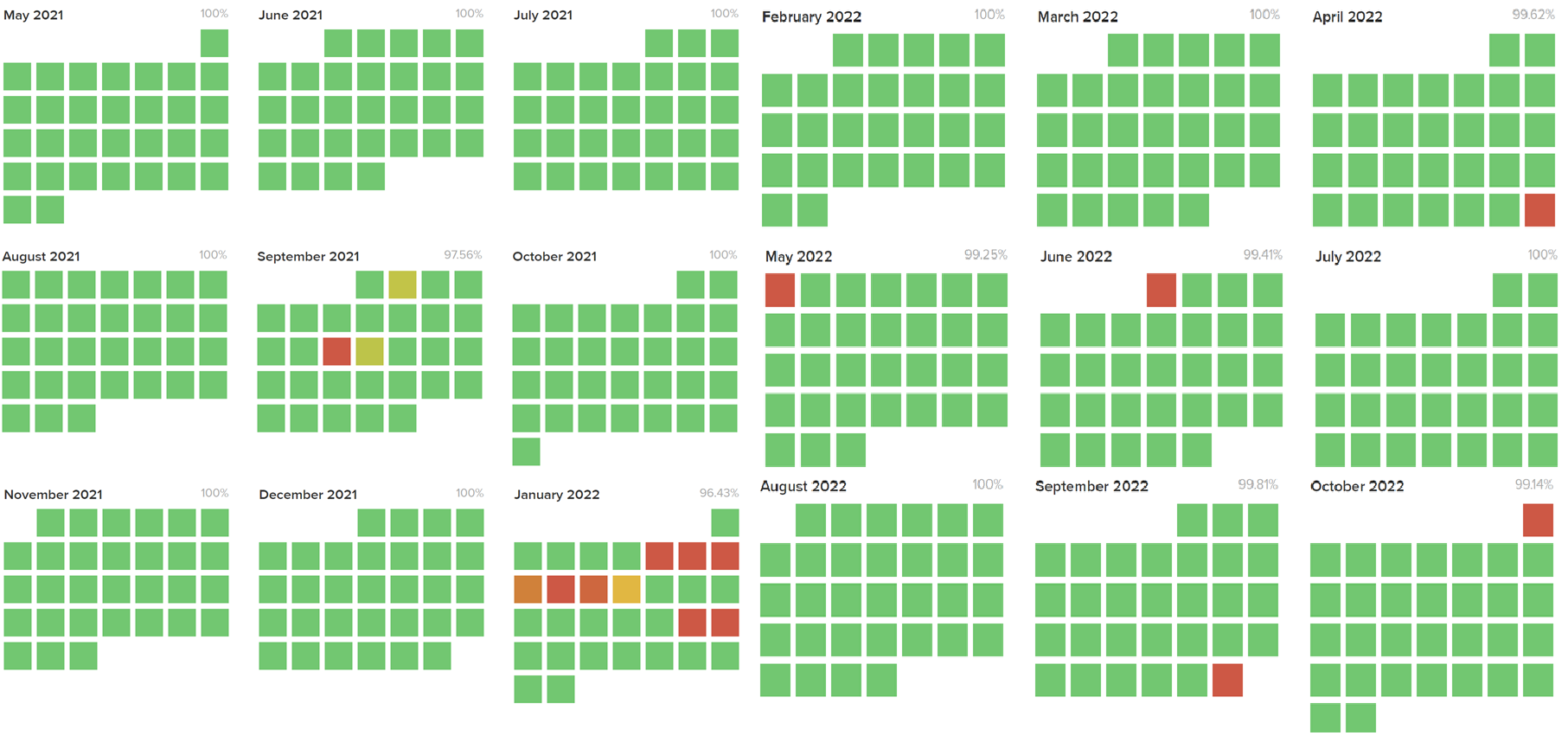
On September 14th, 2021, The Solana network went down for over 20 hours. Due to excessive memory use by nodes, it was a struggle just to bring the network back up. On June 1st, 2022, Solana went down again for 4hrs+; this was caused by a TX bug, effectively stalling the entire chain! On the 1st of October 2022, SOL went down for more than 3hrs due to an invalid block forking the chain.
I will not cover every time SOL went down during this time period, as it is all well documented elsewhere. You get the point; this was SOL's trial by fire, as it was objectively in a terrible state, a buggy mess. If SOL was still in such a bad state today, I would still be a critic. However, on the contrary, it came back stronger every time these problems were successively fixed. This brings us to the following time period:
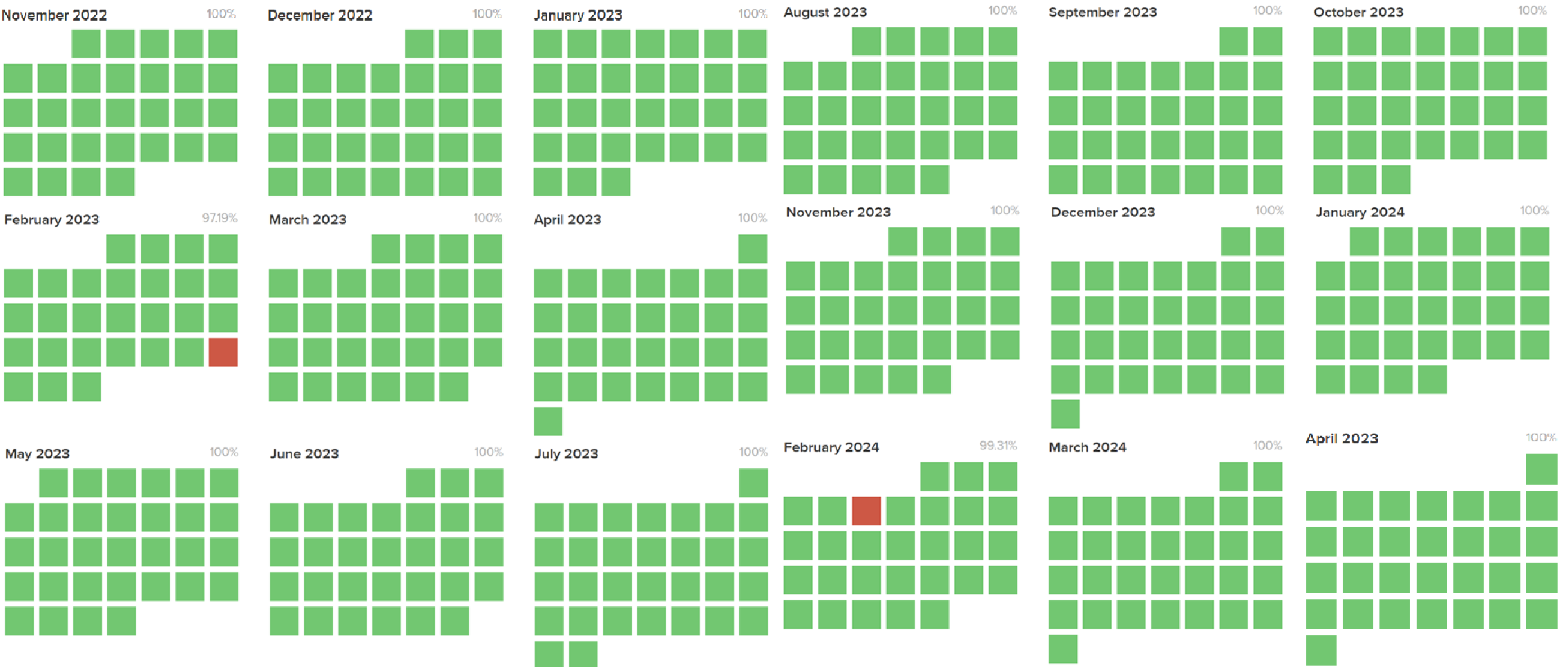
As we can see, the following year was an exponential improvement over previous years, still not good enough, but impressive progress nonetheless. These failures were mostly related to Solana's lack of proper fee markets. The implementation of fee markets over this time period is one of the main reasons I pivoted to support SOL, as it paved the way for perfect stability the following year:
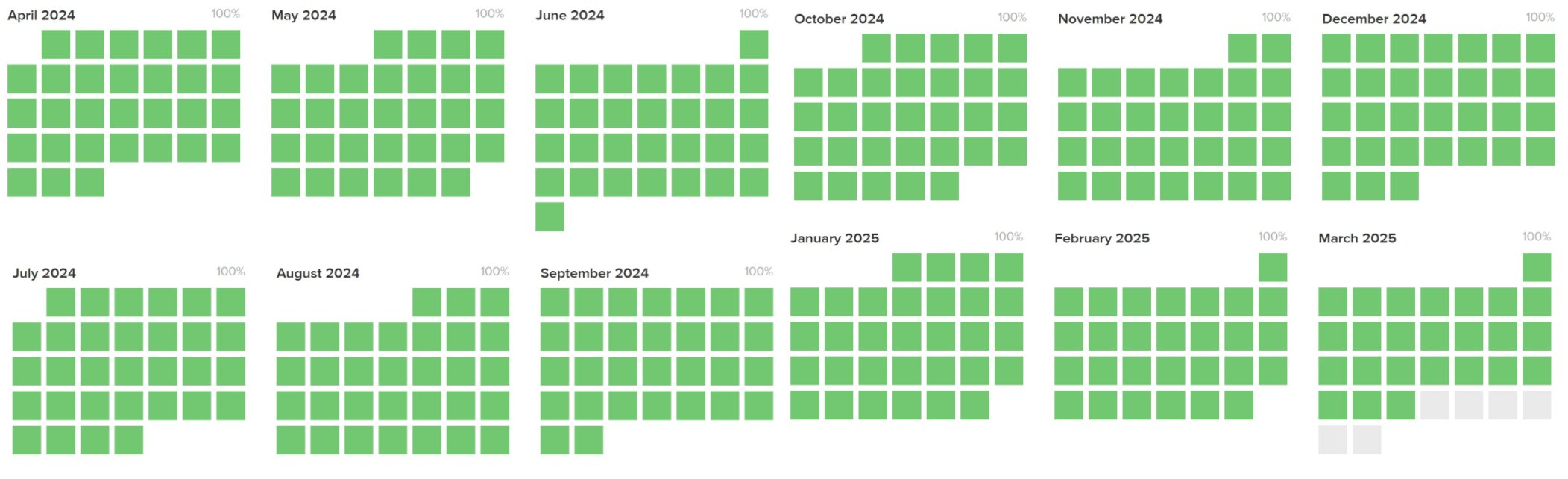
There were still other problems: Congestion, spam, RPC failures, networking bottlenecks, etc. All normal growing pains for a blockchain setting new record highs in terms of usage. What matters is that there was no downtime, a dramatic improvement over previous years. Demonstrating a growing maturity as SOL fixed all of the problems that caused the past instability.
Fake TPS Metrics
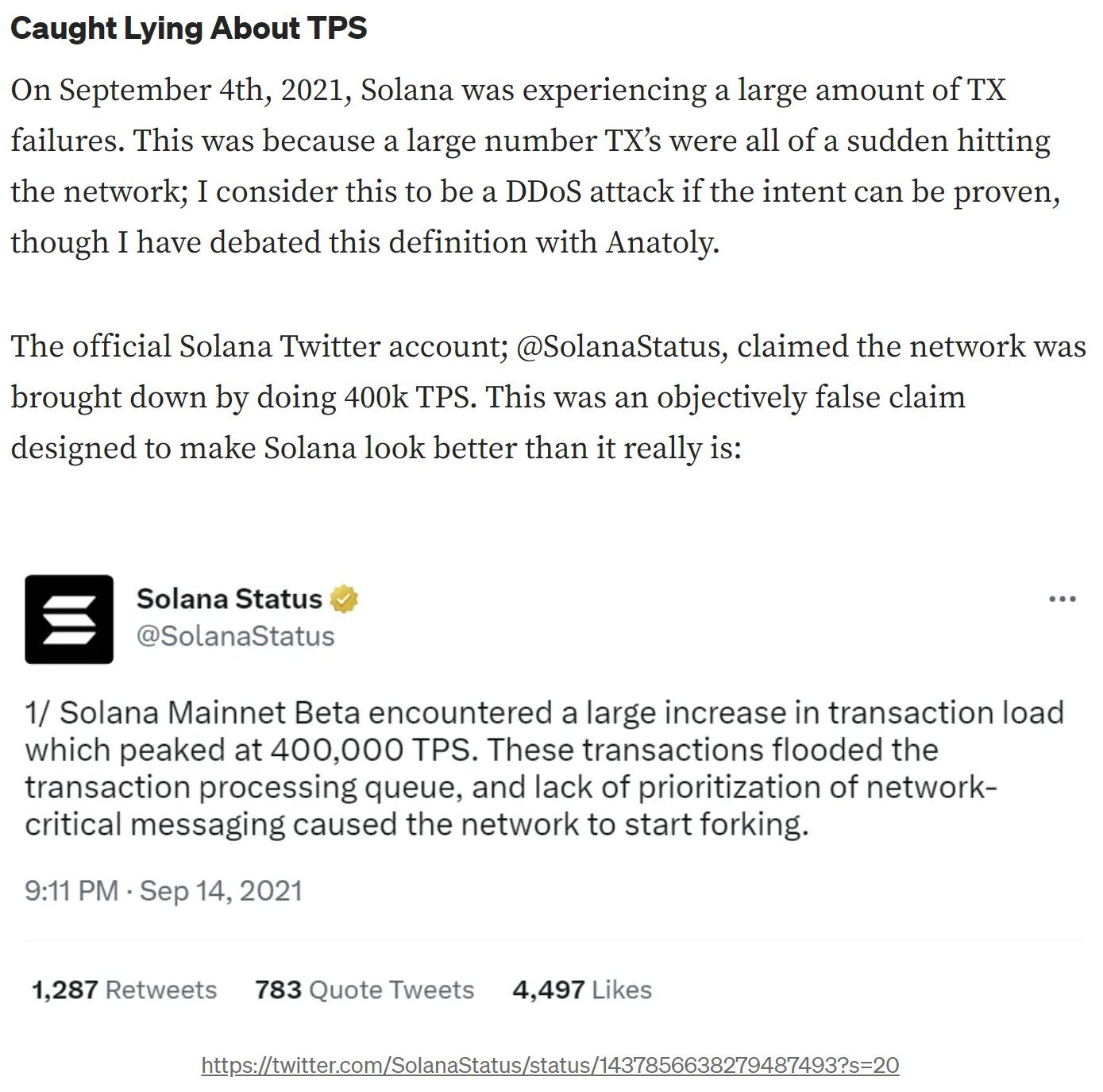
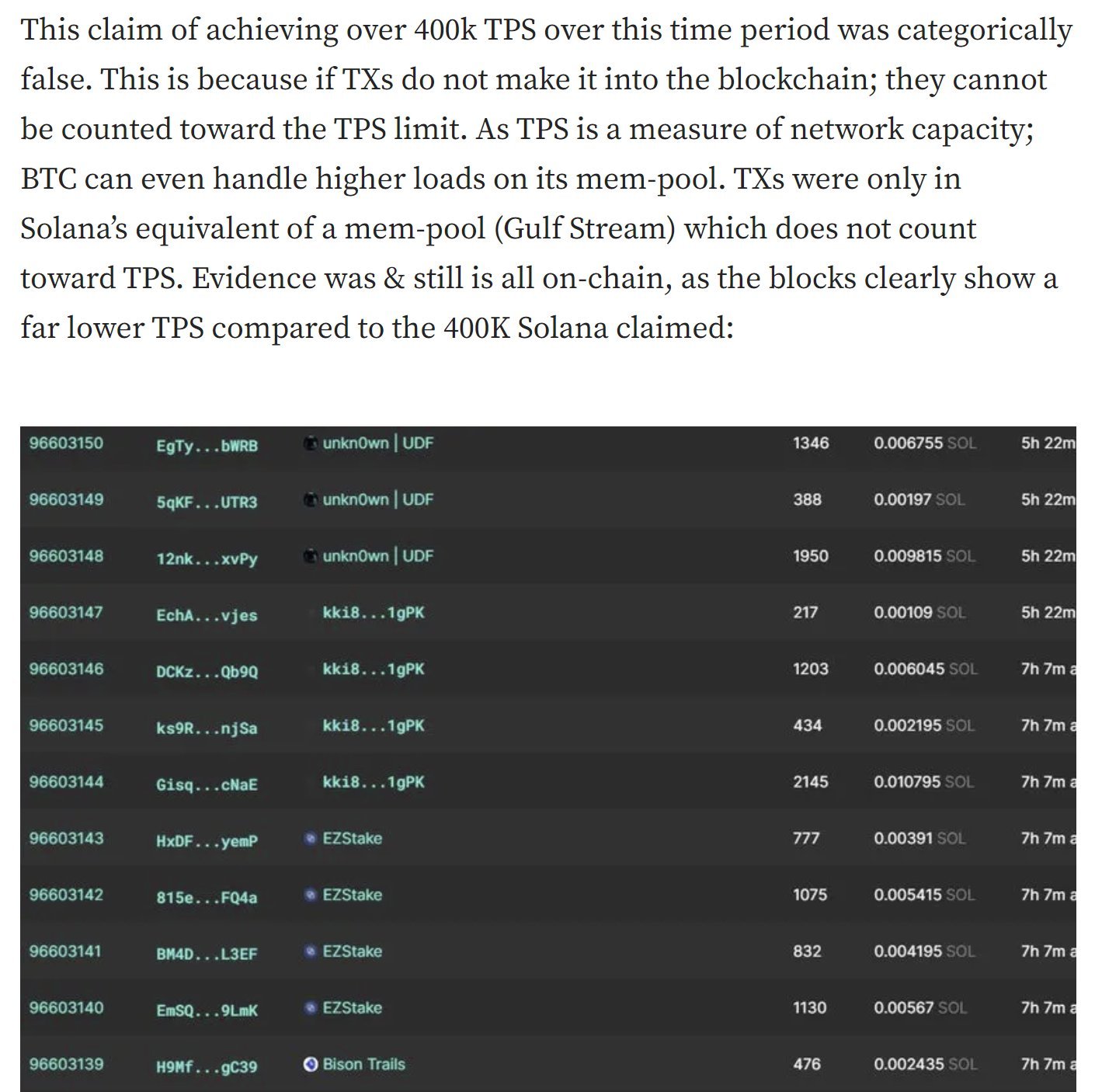
Now we get to the fake usage numbers: When I first called this out in 2021, there was very little real usage. This is why SOL claiming 40k+ TPS at that time was a straight-up lie!
Something I also called out as BS at that time; this is also so obvious now because SOL has, in fact, cleaned its communication up since then, as it no longer makes such outrageous claims around TPS; Solana's leadership is in fact now far more honest in how it communicates with the outside world.
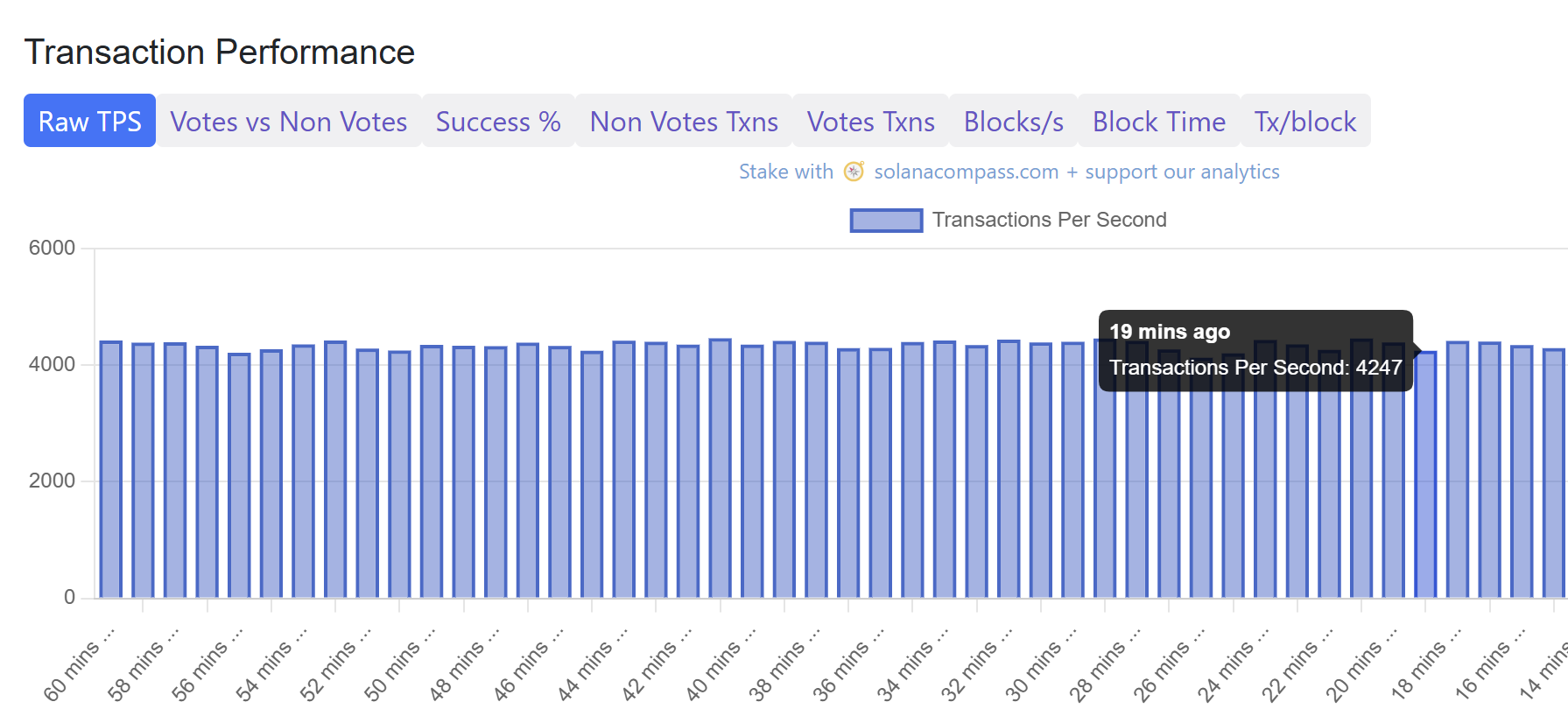
Even though TPS figures can arguably still be misleading today. The adjusted figures are still extremely impressive, even according to the most conservative estimates! Let me break down the math for you, starting off with raw TPS, which is currently at 4247:
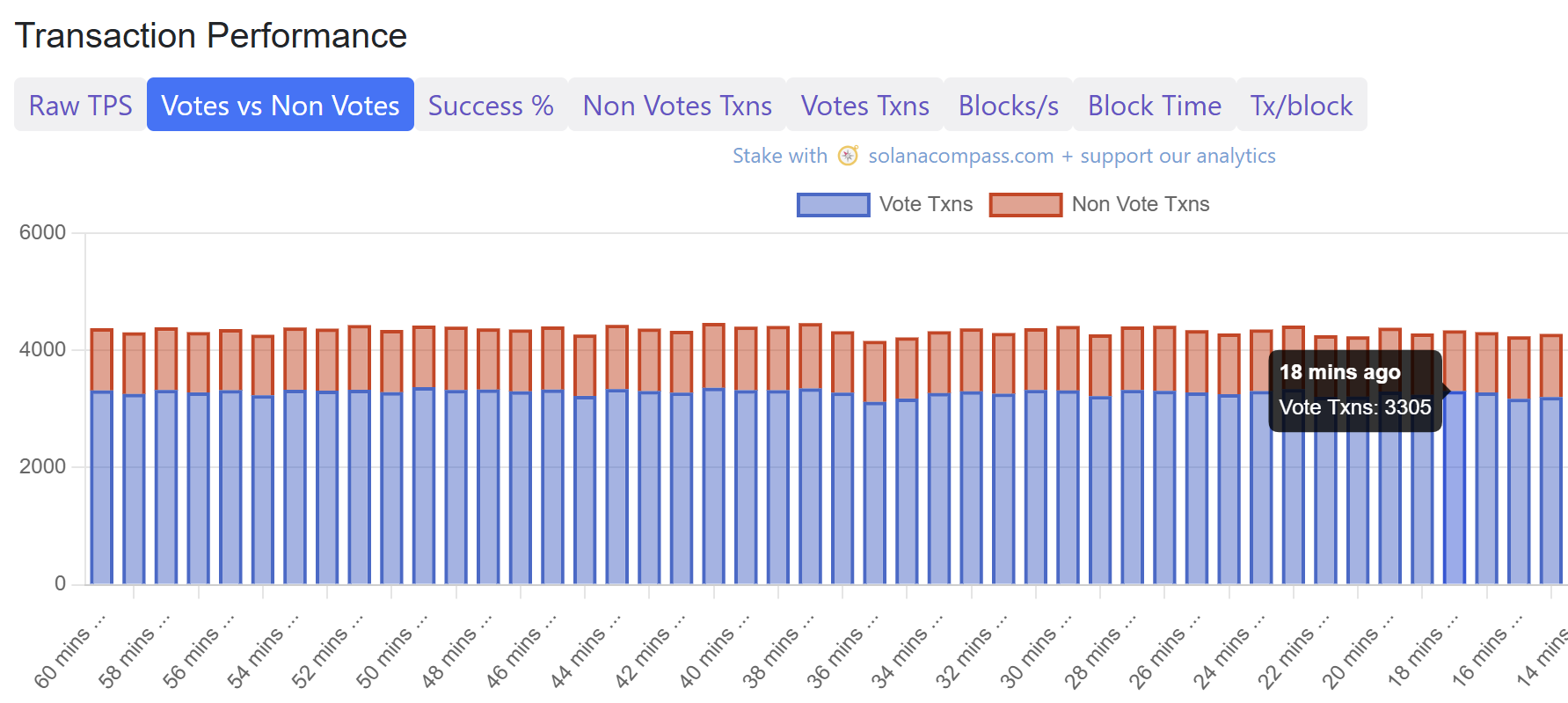
Now we remove vote TXs (consensus messaging), which leaves us with 1109 TPS & we can also remove "failed TXs" purely for the sake of argument as well.
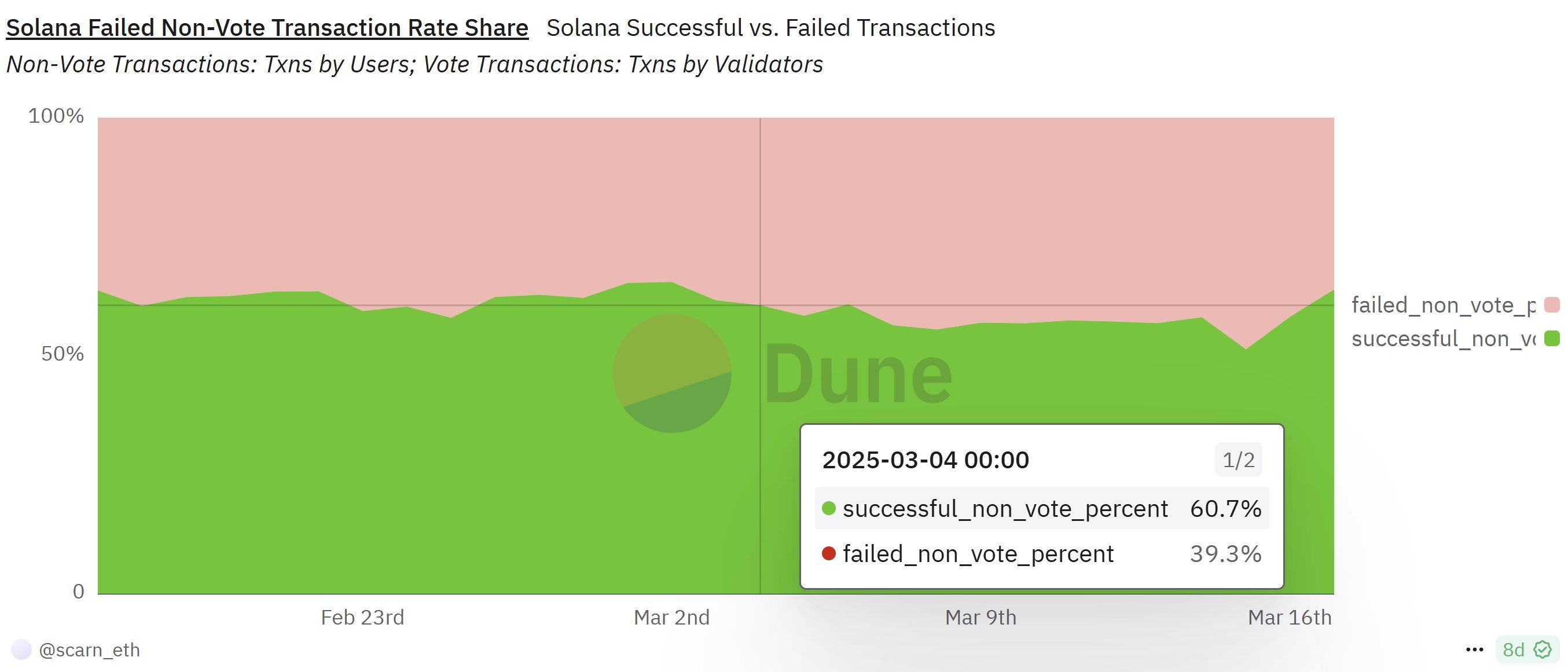
So, 4247 raw TPS - voting TXs = 1109; then remove "failed TXs" -40% = 665
That is still more usage than all other chains combined today!
Making SOL the clear leader in decentralized utility. This is also what makes some of the present-day critiques so unfair, as they make it seem as if SOL is not the leader in usage, which it so clearly is today, even according to the most conservative estimates!
It is also not entirely fair to deduct for "failed TX," as they are meant to fail & pay a fee. Because these TXs are primarily driven by sophisticated actors who are essentially double-spending their own TXs for faster block inclusion while expecting most of these to fail. This does not at all reflect the normal TX failure rate for users, which, according to my own testing, is below 0.2%, a perfectly reasonable range.
However, purely for the sake of argument, we excluded failed TXs & SOL still comes out on top!
Fake TVL Metrics
The same can also be said for the TVL figures, which were massively inflated at times:
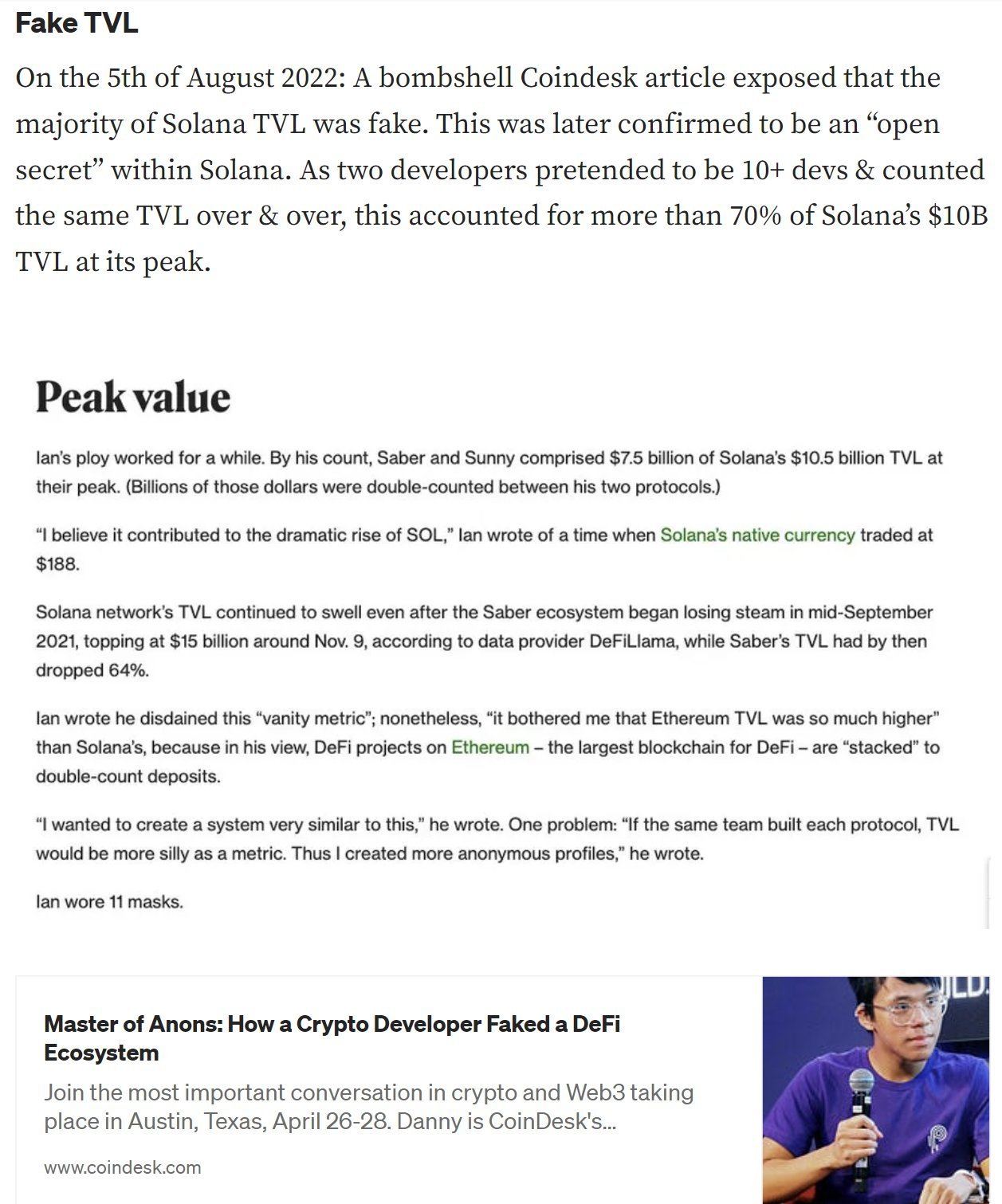
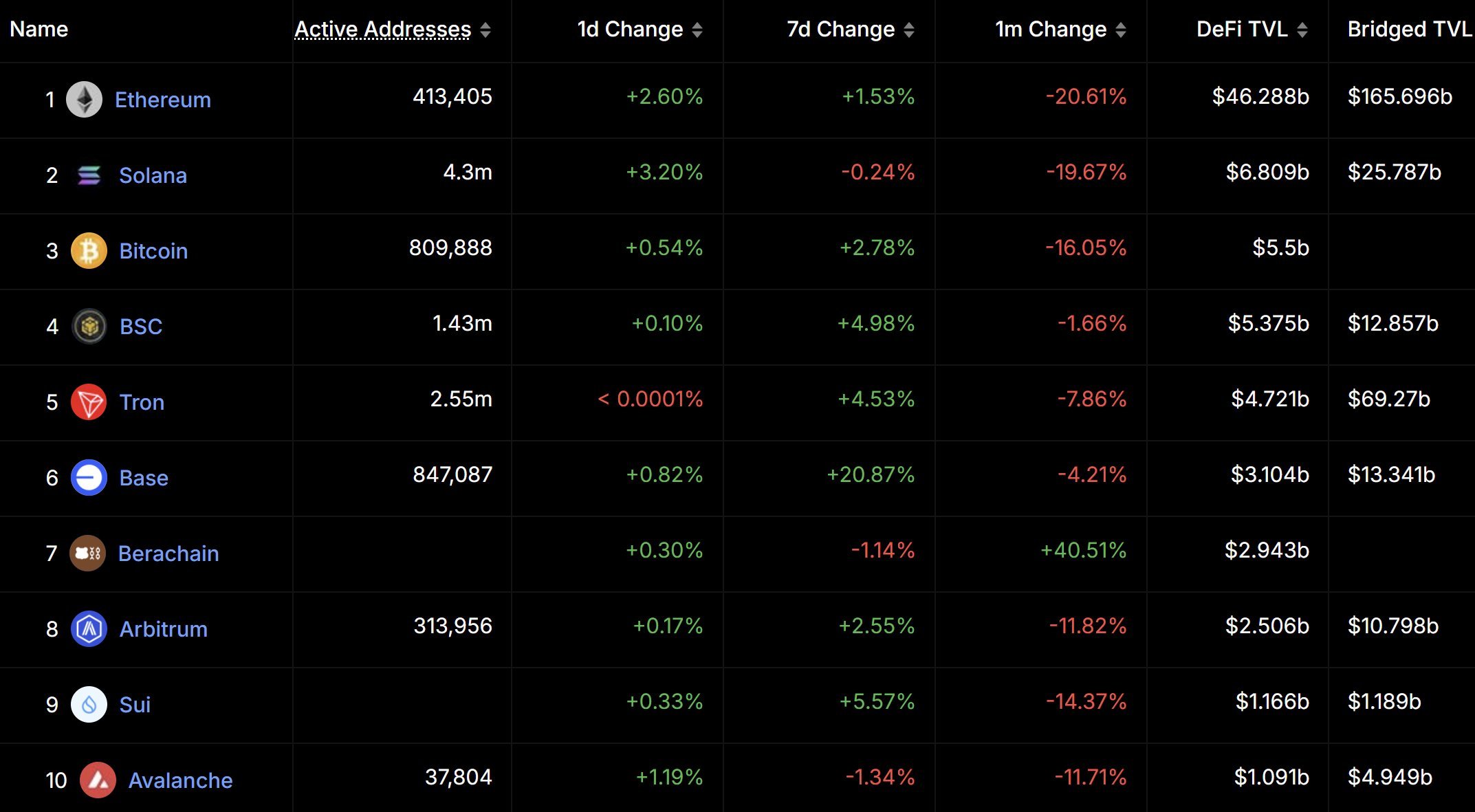
These were, fortunately, only growing pains as ecosystems adjusted, as now that TVL metrics are more fairly compared, it is not perfect, but no blockchain is with how this is counted. We can at least say that the same standards are now applied consistently across blockchain ecosystems.
Putting SOL at a respectable $6B while growing fast, giving it a very bright future:
Revenue
Many still deny reality, even as L1 and DAPP revenue break all-time highs!
What many fail to understand is that revenue metrics specifically cannot be faked, as SOL is sufficiently decentralized to ensure that this is the case.
That is because the only way to "fake" these fees is for the "spammer" to spend all of those fees, as you cannot control which validators get these fees in the end. Forcing the "spammer," in this case, to actually pay for all those fees! This is why fee revenue cannot be faked.
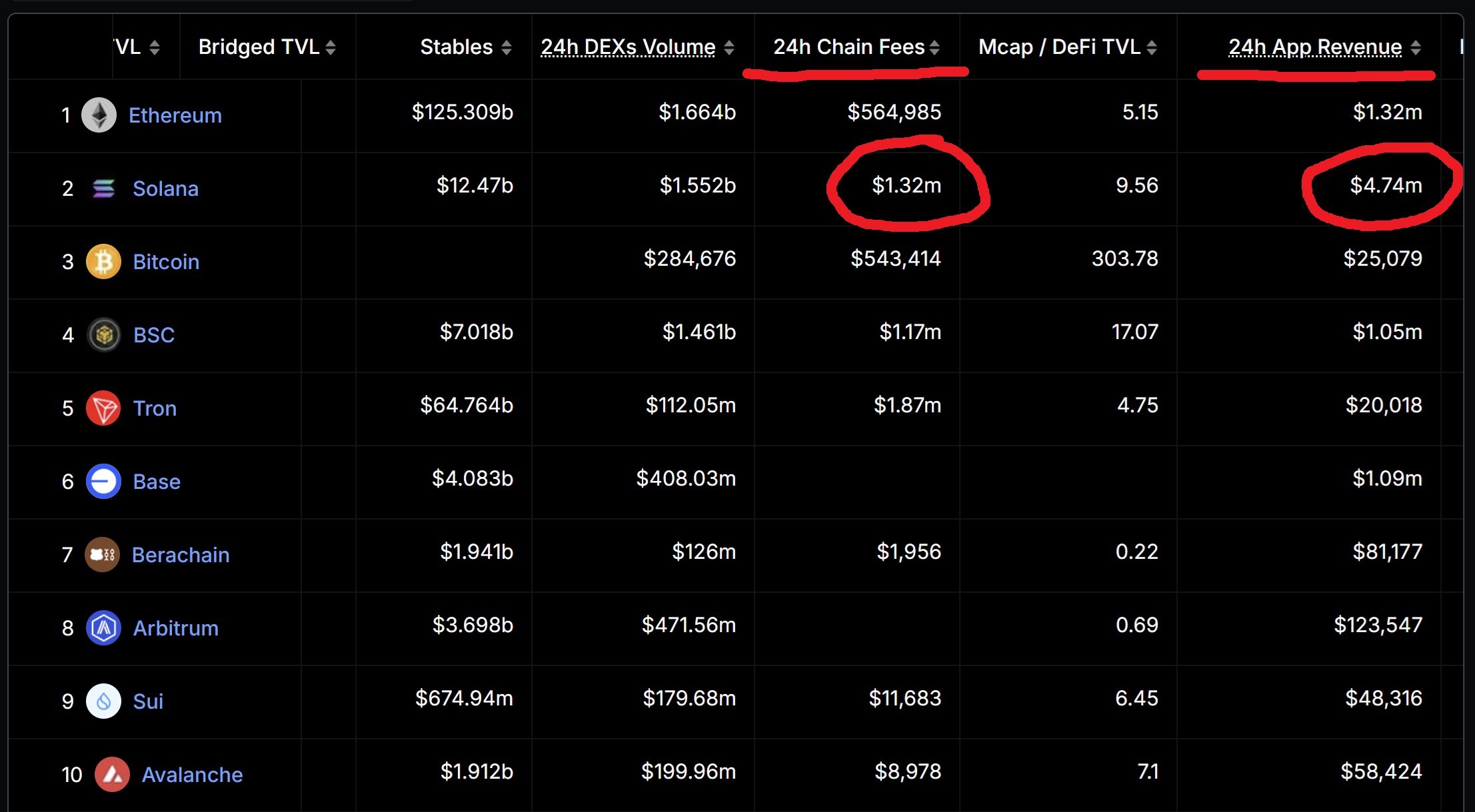
If anyone thinks the SOL founders are paying upwards of $5M per day to "fake" usage, I do not know what to tell you, as you are now in crazy conspiracy theory territory. Maybe I would suggest to look at your bags as a source of bias.
Arguably, revenue is the single most important metric, as it is what proves the use case for cryptocurrency while providing us with a solid and sustainable foundation for decentralization & security far into the future.
Dangerous Design Trade-Offs
Some of the design decisions, such as PoH & Turbine, do trade decentralization for speed. I will bite the bullet on this one, so what does that mean? In practice, it lowers the threshold for attack;
To guess, by maybe around 20%? It is a small reduction in economic security, nonetheless! As it allows an attacker to DDoS the next validator line to become a leader, thereby lowering the effective stake required for a "51% attack", I explained this in more detail in my old critique:
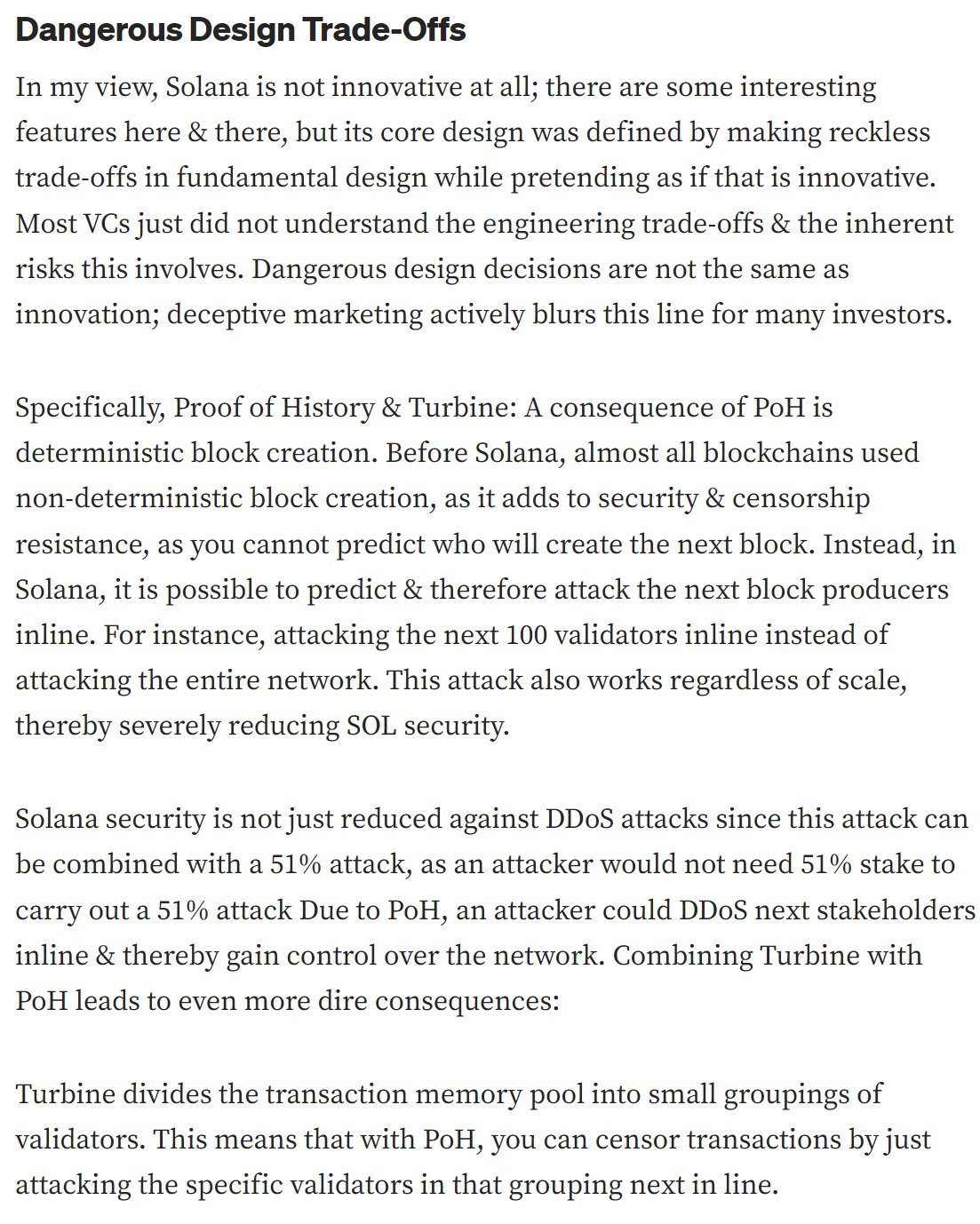
SOL's market cap is still 3x larger than the next L1 below, giving it more security than the next L1 down in line despite this trade-off! Does that make this particular trade-off worthwhile? That is hard to say;
However, what we can say is that SOL is far from being insecure now, as it ends up balancing out. Because in practical terms, SOL is actually far more secure than its closest competitors further down in market capitalization
Decentralization is a spectrum with multiple interacting levers. What I mean by this is best illustrated with an example;
A high-capacity chain with 10k nodes running on supercomputers is more decentralized than a low-capacity chain with 100 nodes on Rasberry Pi's!
This is an extreme example, but it highlights my point. This is why, despite high node requirements and despite centralizing design decisions. SOL is, in fact, very decentralized for its size! As scale plays an important role in practical decentralization. SOL proves this thesis with a well-distributed stake spread over 1.3k validators:
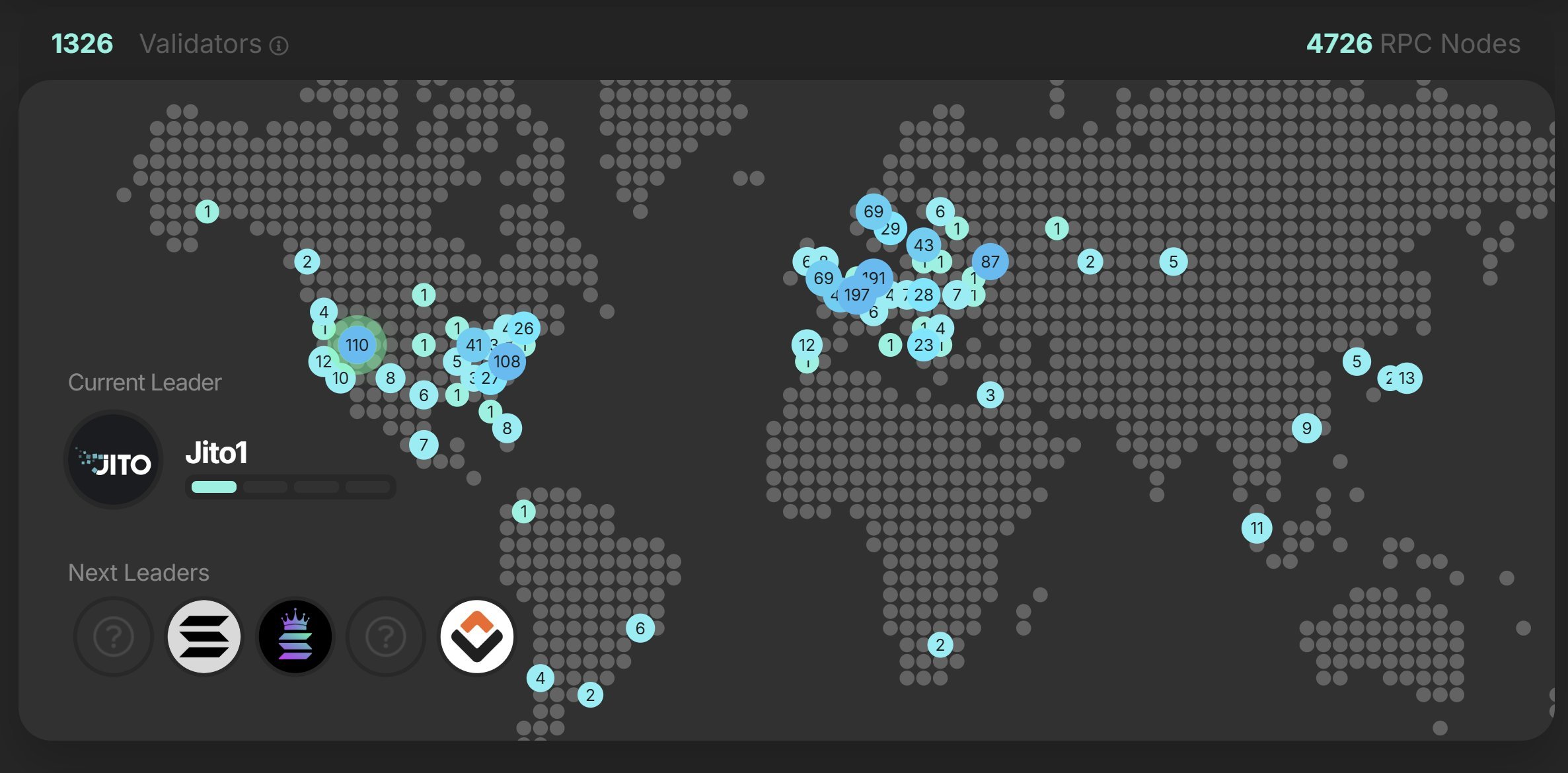
This actually proves long-standing theories and debates around preserving decentralization that date back to the block-size civil war in BTC. There has always been a tension between scaling and decentralization. This is most often exemplified by the "blockchain trilemma." The solution is striking the correct balance between two extremes, as either end of that spectrum leads to irrelevance, either by being useless or too centralized.
Thereby achieving Satoshi's original goals! So, to see that vision fulfilled within SOL is a dream come true after BTC's and ETH's betrayal of that vision. Hopefully, explaining where I am coming from better as an old-school big blocker bitcoiner from the class of 2013 and why I now support SOL instead.
Governance & Client Diversity
SOL also has multiple competing clients developing the L1, this is a big deal in terms of decentralization, critical even! Without multiple clients, blockchains are effectively single-party governance systems. You can vote, but there is only one party to vote for!
Multiple clients also massively increase the resiliency of the network, as this means a single implementation bug can no longer take the entire network down.
We can also count the number of chains that have achieved this milestone on one hand, and SOL is on that exclusive list. So, this achievement is not to be taken lightly at all and demonstrates a deep commitment to decentralization. Because maintaining two clients is more than twice as hard as only maintaining one. Explaining why so few even bother to make this step, preferring to gloss over the glaring points of centralization. All while these "shadow rulers" pretend as if it is a "meritocracy." When in reality, they can gatekeep any change!
SOL also has basic on-chain governance; this is still being worked on and is far from complete. However, that this commitment even exists is leaps and bounds superior to BTC and ETH, which are, from my perspective, effectively dictatorships when it comes to decision-making around rule changes.
The fact that SOL recently failed to pass SIMD228 is paradoxically also a huge milestone! Because disagreement & conflict are hallmarks of true decentralization. Think about it... The proposal was supported by all of the top SOL leadership, yet the stakeholders still voted it down! There really is no better evidence for true decentralization than that. The checks and balances of good governance are, in fact, working correctly in the case of SOL now.
Off-Switch
This is one of the more preposterous claims that has been thrown around, I never made this claim in my old critiques either, but it is worth addressing briefly, at least;
There is no "off-switch"! Unlike permissioned chains (XRP & HBAR) or chains with some permissioned elements (ALGO & BNB). SOL has ZERO permissioned elements; it is a proper public, trustless & decentralized blockchain; that is simply an undeniable fact!
The misunderstanding might come from not understanding the difference between a blockchain halting and having an actual off switch. Consensus is complex; there are multiple ways in which a chain can stop without it being the result of centralized control. I won't spend any more time on such ignorant criticism here, as anyone with even a moderate technical understanding knows this is true.
Fraud & Lies
Fraud and lies are more difficult things to turn the other cheek towards. There was a pattern of bad behavior over several years, as I documented in my old critiques. The SOL team has definitely cleaned up their act since then, both in the honesty of their communication and in their professionalism.
However, the ugly truth remains that in 2020, the SOL team did lie about the circulating supply. Even if these amounts are irrelevant to today's market, it certainly does still count as a regrettable part of SOL's past. I covered this in great detail as part of my old critique in the interest of full transparency; I have even included the evidence here:
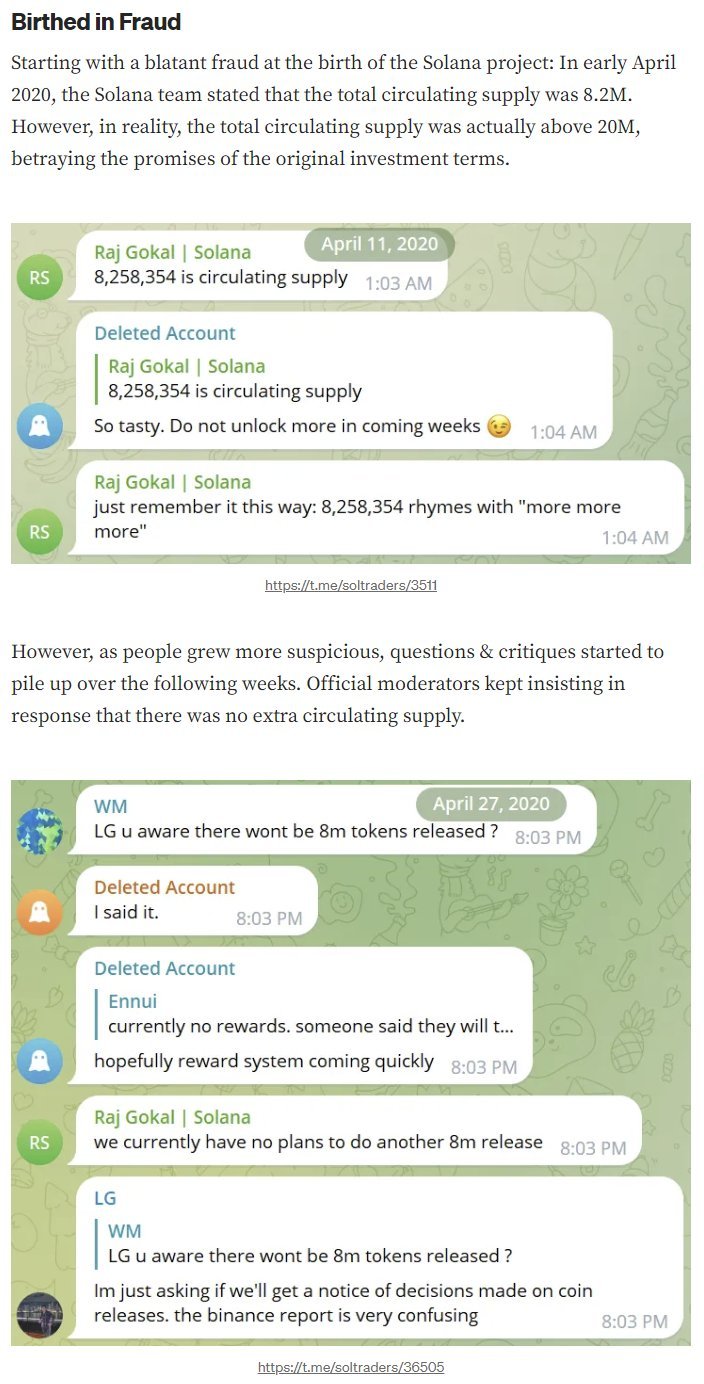
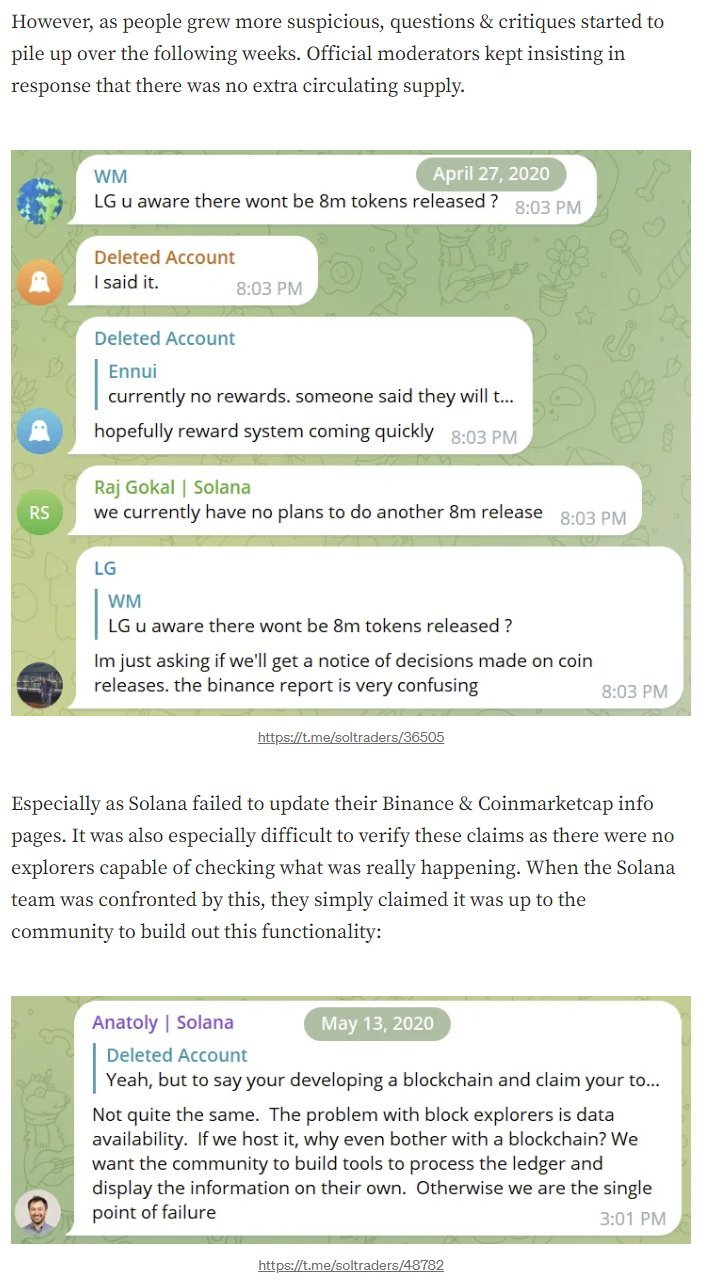
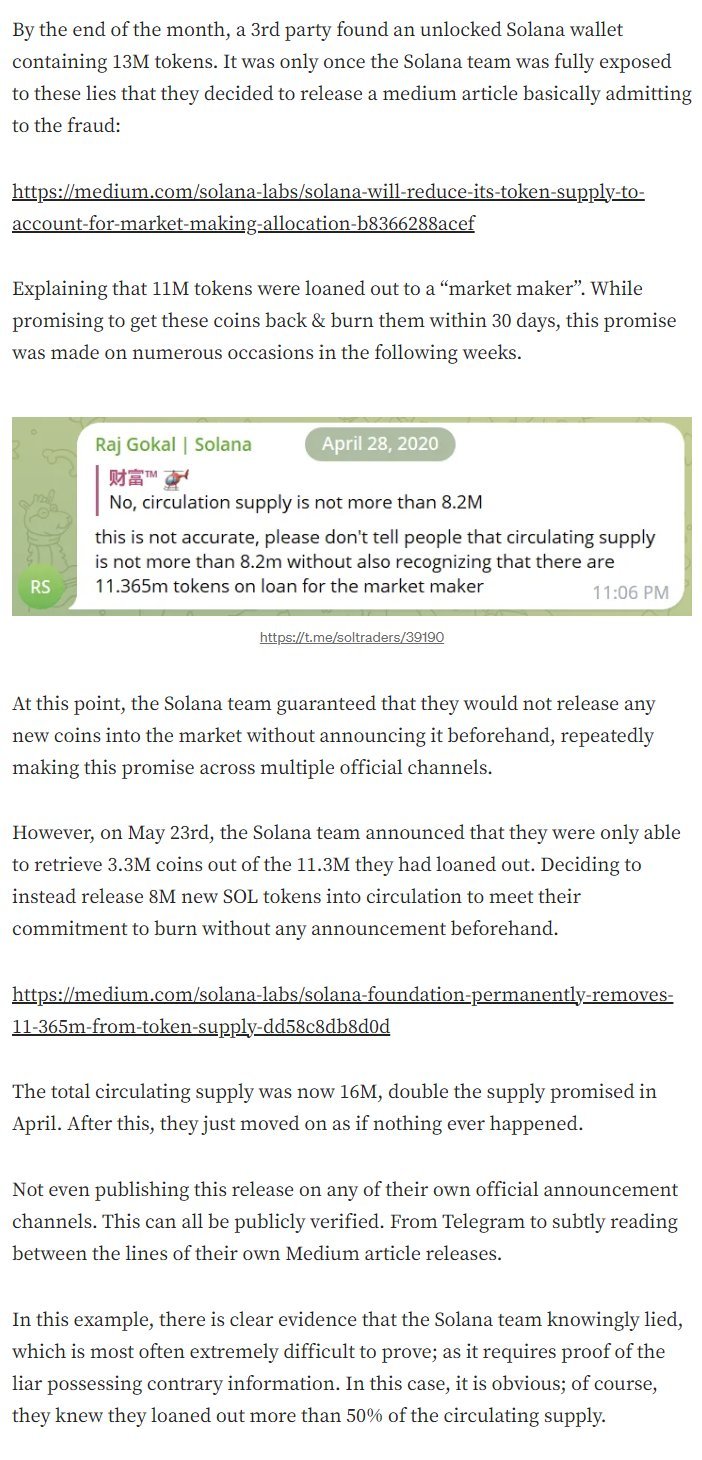
My response to all of this comes down to the concept of decentralization: A blockchain can transcend its founding! Decentralization means that SOL is not defined by its past leadership. Especially as mass adoption occurs, the leadership gets diluted and changes. That means we can support SOL even if you do not trust its current leadership!
Personally, I have regained faith in the leadership because the "pattern of bad behavior" stopped! However, my main point here is that you do not actually need to. That is the whole point of blockchain technology, after all.
That is what decentralization means: You do not actually need to trust anyone! The sins of the past remain, but we can keep our eyes on the future.
The Old Critique
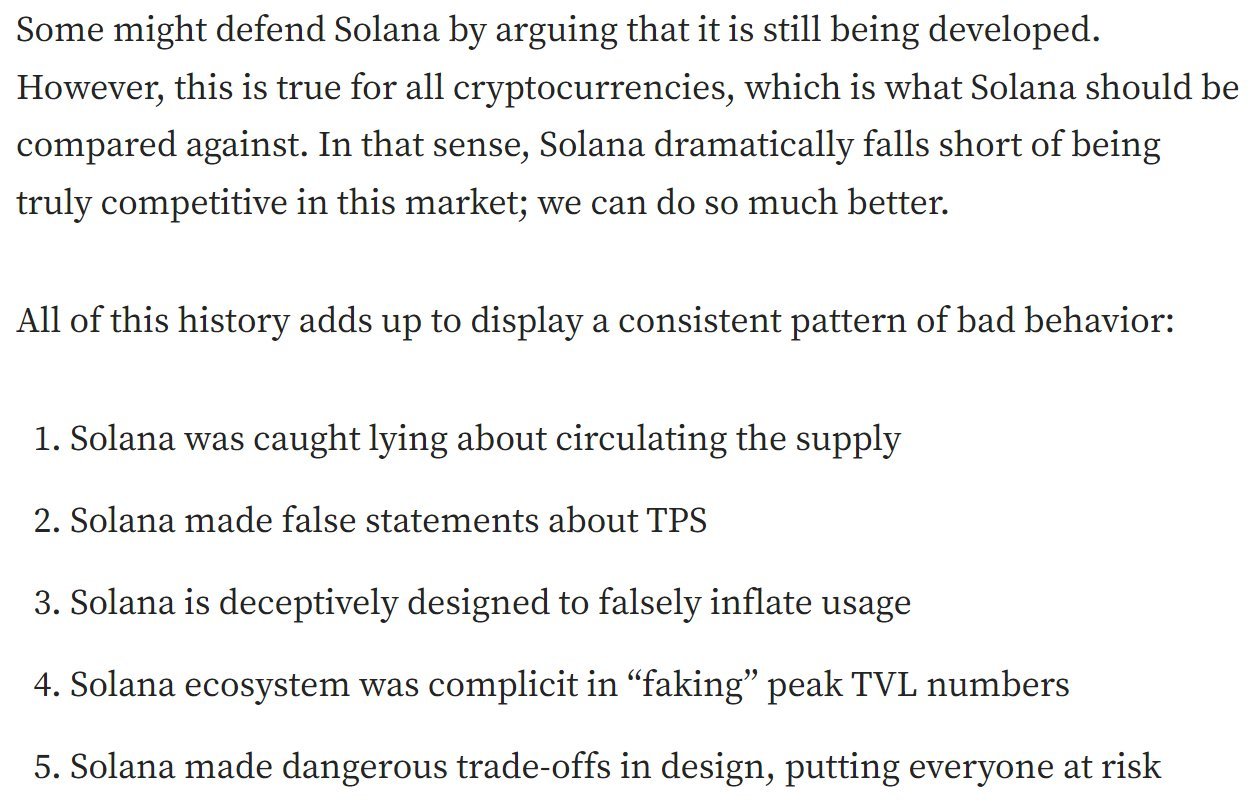
To summarize my old critique, as I also did back then:
- SOL's leadership lied about supply in 2020, but it has no material impact on the present
- SOL cleaned up communication & real TPS is now breaking new records!
- Explorers now show "true TPS"
- TVL is no longer "fake"
- Most of the dangerous trade-offs have been fixed!
You can read my old critique below; it is still on Medium for all to see.
I have always stubbornly stood up for crypto principles, going against the grain and constantly pivoting as cryptocurrency evolves. Some have accused me of being a shill, as my pivot certainly must have seemed sudden.
This accusation is not only a mere ad hominem but also ridiculous on the face of it, considering how negative I was towards SOL back then. I would be the last person on their payroll even if they did such a thing!
Perfect Is The Enemy Of Good
If we are too picky, we will fragment into thousands of chains, which is not good for crypto! Or, at the very least, we should allocate our support rationally when it comes to achieving the goals of the cypherpunk movement.
Remember, this is coming from the guy that rejects 95% of chains! Even loudly rejected the number 1 & 2 chains by market cap (BTC & ETH) by 2016 and 2022, respectively, due to their pivot away from on-chain scaling.
That is why we better well have a damm good reason to reject the third biggest chain (SOL). I make my life hard enough as it is, managing the oldest liquid fund in the world and taking such contrarian positions. That is, in part, why I can no longer in good conscience be a SOL critic, as they have fixed the very flaws I critiqued and achieved the dream... I had to become an admirer.
Even if the most popular content I ever released were my SOL critiques. Leading much of my audience to end up hating me over the pivot, while much of the SOL community is understandably wary of a former critic, I guess that is what it means to be a free thinker sometimes.
So sure, there are chains that are technically better out there, but is the path toward mass adoption as smooth as supporting SOL? I would much rather quote real revenue numbers to clients than theoretical ones...
What matters is that SOL is sufficiently decentralized to achieve censorship resistance, immutability, financial sovereignty, and more, all on a chain that can achieve massive scale now; that is what matters at the end of the day, after all.
Conclusion
As a value investor with a thesis based on monolithic/integrated scaling. It was only natural that I pivoted towards SOL as it gained traction.
SOL is far from perfect; it was not even my favorite design at that time! However, we must respect success in usage as that is where true value lies.
Scalability without decentralization is pointless; the inverse of that is also true, ofcourse; this is not something SOL ignores either, contrary to the claims of its detractors.
In an environment where ETH decided not to scale the L1 whatsoever, SOL has become the new king. There are certainly many more contenders to the throne & diversification is still key. However, we also cannot ignore SOL's clear dominance in the market now in the areas that really matter: Utility, usage & revenue.
To ignore that at this stage of the game can only come from a massive bias rooted in misinformation about SOL or its competitors. We all need to update our damn thesis! That is why being able to change our minds is a superpower in this industry and life in general.
I say this as an early BTC and ETH adopter who turned critic when those chains pivoted away from on-chain scaling. SOL's success deserves our praise as cypherpunks! As the masses can only be liberated through scalable tech, SOL achieves that beautiful vision right now.
Perfect is the enemy of good, and SOL is good enough! Give me freedom or give me death, as you, too, will learn to stop worrying and love the bomb.
Original Text: https://x.com/Justin_Bons/status/1912221453111496887


'%3e%3cpath%20opacity='0.7'%20d='M16.1588%2074.0276L15.9724%2055.5393H7.01802C3.1496%2055.5393%200%2052.4322%200%2048.6151V12.0493C0%208.23218%203.1496%205.12512%207.01802%205.12512H65.0898C68.9582%205.12512%2072.1078%208.23218%2072.1078%2012.0493V48.6151C72.1078%2052.4322%2068.9582%2055.5393%2065.0898%2055.5393H35.3688L16.1573%2074.029L16.1588%2074.0276ZM11.7358%2015.394C11.5431%2015.3939%2011.3523%2015.4318%2011.1743%2015.5055C10.9963%2015.5792%2010.8345%2015.6873%2010.6983%2015.8235C10.562%2015.9597%2010.4539%2016.1215%2010.3802%2016.2995C10.3065%2016.4775%2010.2685%2016.6683%2010.2685%2016.8609C10.2685%2017.0536%2010.3065%2017.2444%2010.3802%2017.4224C10.4539%2017.6004%2010.562%2017.7621%2010.6983%2017.8984C10.8345%2018.0346%2010.9963%2018.1426%2011.1743%2018.2163C11.3523%2018.29%2011.5431%2018.328%2011.7358%2018.3279H60.1461C60.5351%2018.3278%2060.9081%2018.1732%2061.1832%2017.8981C61.4582%2017.623%2061.6127%2017.2499%2061.6127%2016.8609C61.6127%2016.4719%2061.4582%2016.0989%2061.1832%2015.8237C60.9081%2015.5486%2060.5351%2015.3941%2060.1461%2015.394H11.7358ZM11.7358%2025.6628C11.3468%2025.6629%2010.9738%2025.8175%2010.6987%2026.0926C10.4237%2026.3677%2010.2692%2026.7408%2010.2692%2027.1298C10.2692%2027.5188%2010.4237%2027.8919%2010.6987%2028.167C10.9738%2028.4421%2011.3468%2028.5967%2011.7358%2028.5968H60.1461C60.5351%2028.5967%2060.9081%2028.4421%2061.1832%2028.167C61.4582%2027.8919%2061.6127%2027.5188%2061.6127%2027.1298C61.6127%2026.7408%2061.4582%2026.3677%2061.1832%2026.0926C60.9081%2025.8175%2060.5351%2025.6629%2060.1461%2025.6628H11.7358ZM11.7358%2035.9316C11.3468%2035.9317%2010.9738%2036.0863%2010.6987%2036.3614C10.4237%2036.6365%2010.2692%2037.0096%2010.2692%2037.3986C10.2692%2037.7876%2010.4237%2038.1607%2010.6987%2038.4358C10.9738%2038.7109%2011.3468%2038.8655%2011.7358%2038.8656H30.8065C31.1955%2038.8655%2031.5686%2038.7109%2031.8436%2038.4358C32.1187%2038.1607%2032.2732%2037.7876%2032.2732%2037.3986C32.2732%2037.0096%2032.1187%2036.6365%2031.8436%2036.3614C31.5686%2036.0863%2031.1955%2035.9317%2030.8065%2035.9316H11.7358Z'%20fill='%239096AA'/%3e%3cpath%20opacity='0.2'%20d='M80.9552%2020.059C84.8236%2020.059%2087.9732%2023.166%2087.9732%2026.9802V57.2336C87.9732%2061.0507%2084.8236%2064.1578%2080.9552%2064.1578H70.9284V82.1224L53.577%2064.1578H31.8496L37.8349%2058.3984H67.5529C71.4213%2058.3984%2074.5709%2055.2899%2074.5709%2051.4743V20.056H80.9552V20.059Z'%20fill='%239096AA'/%3e%3c/g%3e%3cdefs%3e%3cclipPath%20id='clip0_278_279'%3e%3crect%20width='88'%20height='88'%20fill='white'/%3e%3c/clipPath%3e%3c/defs%3e%3c/svg%3e)